Civilisation is Subterranean.
Burrowing Lessons From the Past & Digging the Future.
Michal Karlubík · A letter to SoTA
Dear SoTA,
Picture a tree.

Nice. Except that’s not the whole tree.
That’s the crown. The machinery keeping it alive is below.

This is the whole tree.
Now picture a city. Behold, London.
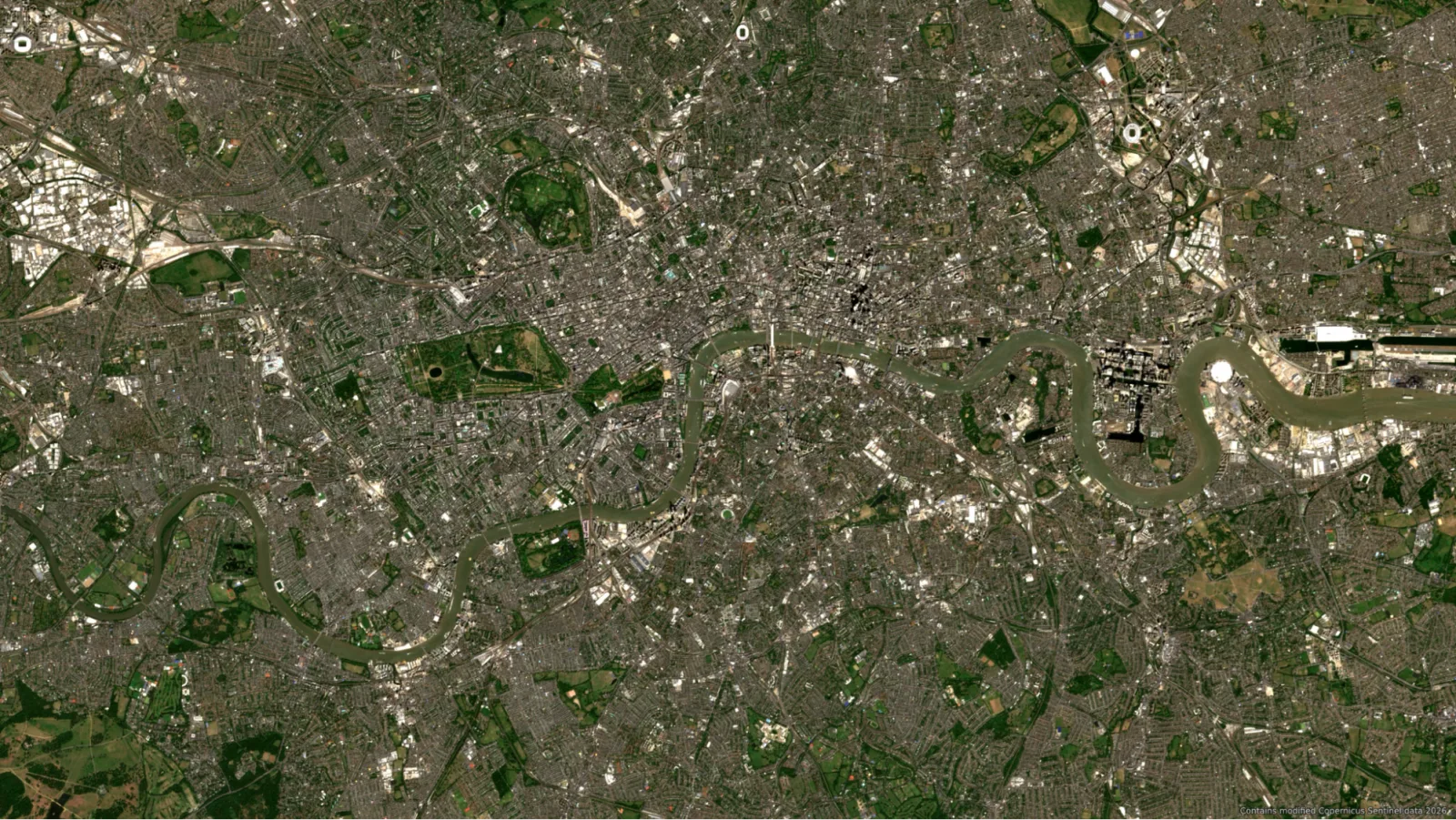
Except, much like the tree, that is not London either. Not all of it, anyway.
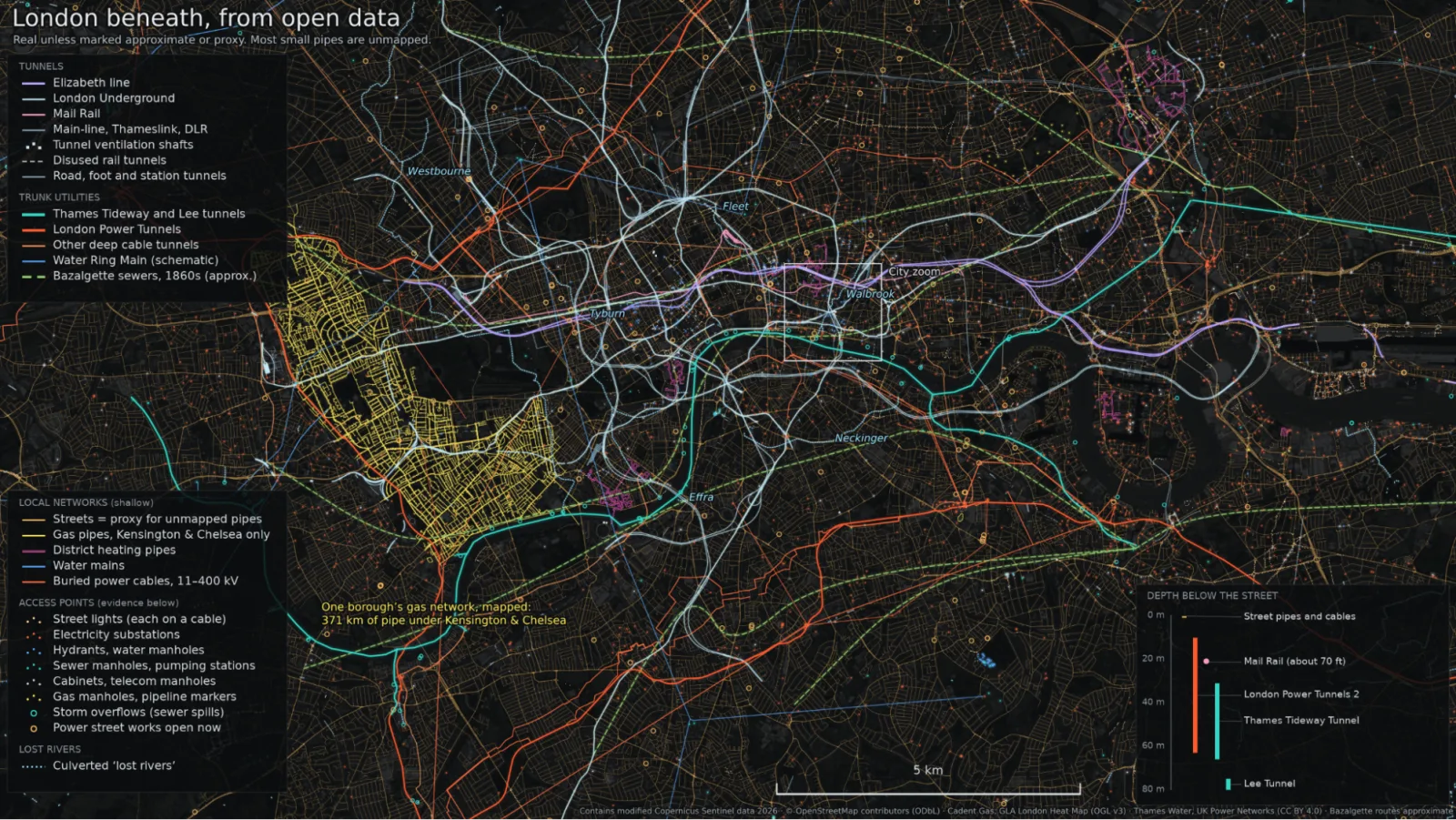
Humans figured out the value of underground infrastructure remarkably early.
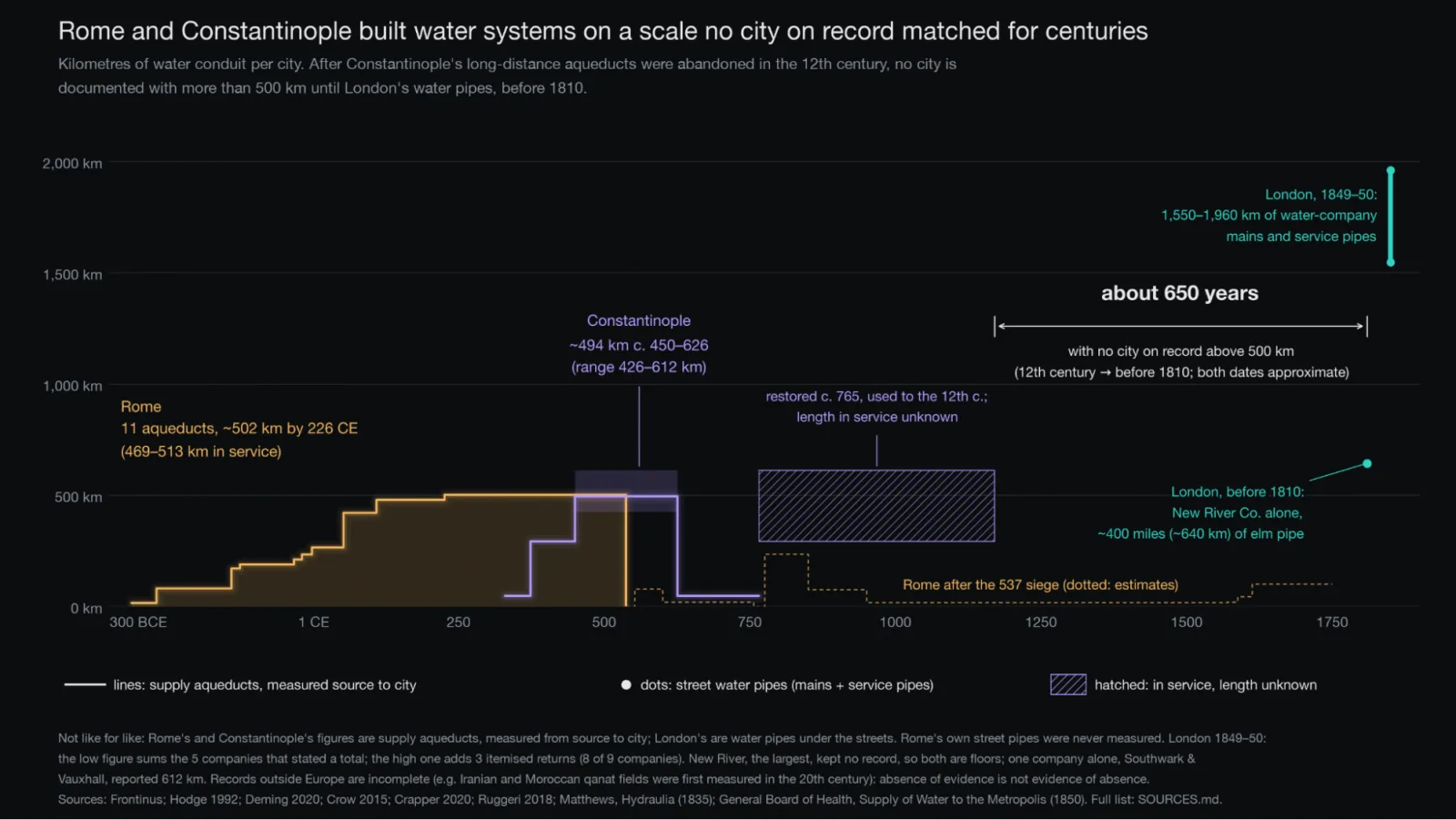
By 226 CE, Rome had more than 500 km of aqueducts. Constantinople approached the same scale a few centuries later. After its long-distance system fell out of use, no city on the surviving record is documented above 500 km again until London.
Then something else happens.
As cities get richer, their underground networks seem to grow with them.
Across Paris, Berlin, New York and a set of Chinese cities, metres of sewer per inhabitant rise remarkably closely with GDP per head.
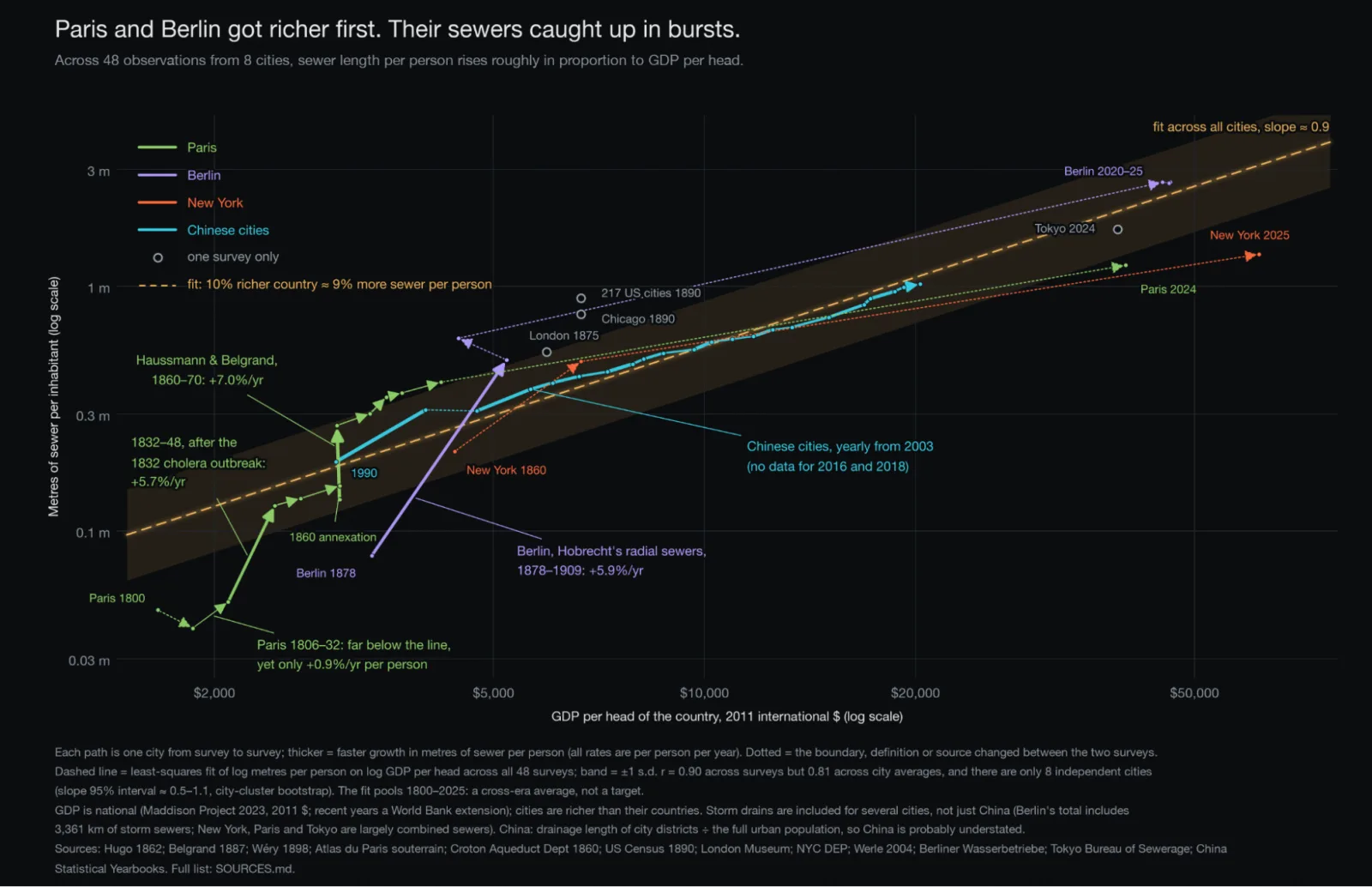
The most compelling interpretation is that underground infrastructure follows prosperity. Richer societies build more of it.
As cities industrialise and get richer, they move more of the machinery of everyday life underground: sewage, water, power, transport, communications.
Prosperity shows itself underground.
In Britain alone:
- ~4 million km of buried utilities.
- ~4 million holes dug into the ground every year to install, repair or access them.
- Roughly 10 km of buried pipe and cable for every kilometre of road.
Almost all of it sits within a few metres of the surface.
Victorian London responded to the Great Stink of 1858 by building around 1,900 km of sewers with 318 million bricks. Iran built somewhere around 180,000 to 350,000 km of qanats: hand-dug underground channels carrying water across dry land.
The US today has something like 12.7 million km of buried water, sewer, energy pipe and electricity cable.
Around 33 times the distance to the Moon.
Small underground infrastructure is civilisation.
No city works without a network buried underneath.
the weird part
Since 1970, real world GDP has grown 5x and the population has grown from 3.7 billion to 8.2 billion. Global life expectancy has risen from 58 to 73 years. We invented the internet and connected 6 billion people to it. We took trips to the Moon, sequenced the human genome, built GPS, smartphones and modern AI.
Meanwhile, the basic ways we make small holes through the ground have barely changed.
If you want to put a pipe or cable underground, your options would have been entirely recognisable to an engineer in 1970:
- Trench it: excavate from above, put something in the hole, fill it back in.
- Drill it: use a surface HDD (Horizontal Directional Drilling) rig to push and steer a long string of drill rods through the ground.
- Punch through it: launch a small impact mole that propels itself through the soil, but has very limited steering & range.
- Tunnel it: excavate between shafts using pipe jacking, microtunnelling or, at much larger scales, a tunnel boring machine.
Impact moles appeared in the 1960s. Modern utility HDD dates to around 1971. Microtunnelling appeared in Japan in the early 1970s. What followed was fifty years of incremental optimisation.
The underlying architecture barely changed.
A modern “compact” HDD rig can still weigh more than three tonnes, pushing tens of metres of rigid steel drill rod through the ground and pumping drilling fluid from the surface — sometimes just to install a conduit a few centimetres wide. An impact mole can actually be small, but it usually travels only tens of metres and has very limited control over where it goes.
So the trade-off remains roughly the same:
Small machines cannot really steer. Machines that steer are not small.
There are good reasons for this:
- Reaction force: an HDD rig generates thrust from a multi-tonne machine anchored at the surface. A self-contained burrower has to generate that force against the surrounding soil.
- Spoil: a 100 mm bore produces about 8 m³ of soil per kilometre. A 1 m bore produces around 785 m³. Small boring is a different problem, not simply a scaled-down tunnel boring machine.
- Navigation: there is no GPS underground, and ordinary radio does not travel well through soil.
- Friction: the farther something travels underground, the harder it becomes to keep pushing or pulling it.
why this matters
The UK has around 4 million km of buried utilities and digs roughly 4 million holes every year to install, repair or access them. Around 60,000 times a year, excavation accidentally hits an existing pipe or cable, costing an estimated £2.4 billion.
For fibre, civil works can account for up to 80% of deployment cost. We still dig up roads, bring heavy machinery to site, install a tiny cable or conduit, and then rebuild everything above it.
The scale is enormous. China alone plans to build or upgrade around 770,000 km of urban underground pipelines from 2026–2030.
Most underground infrastructure is not Crossrail. It is small, shallow and very long — and we still build most of it from the surface.
the military case
The same thing matters in defence for a different reason.
Soil is cheap shielding.
A few metres underground can remove people, equipment and infrastructure from many of the sensors that now dominate the surface.
During the Vietnam War, the Viet Cong built roughly 200 km of tunnels around Củ Chi, with hospitals, workshops, command posts and weapons stores. The US 25th Infantry Division even built a base over part of the network.
The tunnels might not be the only reason for America’s failure. Still, cheap earth forced the world’s most formidable military to fight on impossible terms, despite overwhelming technological superiority.
The same pattern repeats.
- Gaza: estimates of the tunnel network are commonly in the 500 to 700 km range. Israel has had to devote enormous surveillance, engineering and military resources to finding and destroying it.
- Sudzha, March 2025: Russian troops reportedly moved roughly 15 km through an unused gas pipeline before emerging near Ukrainian positions.
The asymmetry appears when one side can change the domain entirely. The surface is becoming ever easier to observe as drones, thermal cameras, satellites and persistent sensing get cheaper. Underground, those advantages weaken dramatically.
Going underground changes the terms of the fight.
why now?
Three things have changed at once.
- The machine can think for itself.
Cameras, IMUs, batteries, motors and serious onboard compute now fit inside a body only 10–20 cm across. Navigation and control no longer need to live on a large machine at the surface. - We have better ways to move through soil.
MIT’s RoboClam showed that sediment can be locally fluidised to reduce drag. Root-inspired robots grow from the tip instead of dragging their whole body through the ground. DARPA’s Underminer programme demonstrated autonomous boring, underground localisation and obstacle avoidance. - Autonomy has become possible.
Robots can now map, localise and make decisions in GPS-denied environments with far less human control than even a decade ago.
None of these solves the problem alone. Together, they make a new kind of machine possible.
So the question is simple:
Why can’t I launch a 10 cm robot from a small pit, give it a destination, and have it travel hundreds of metres through ordinary soil by itself?
I can buy a multi-tonne HDD rig that steers through the ground from the surface. Or I can buy a small pneumatic mole that barely steers at all.
What I cannot buy is the thing in between: a small, autonomous machine that carries its own propulsion, sensing, compute and control underground.
An underground drone.
Aerial drones became transformative when the intelligence moved onto the vehicle.
Underground, that transition is only just beginning.
Time to build.
Yours,
Michal Karlubík